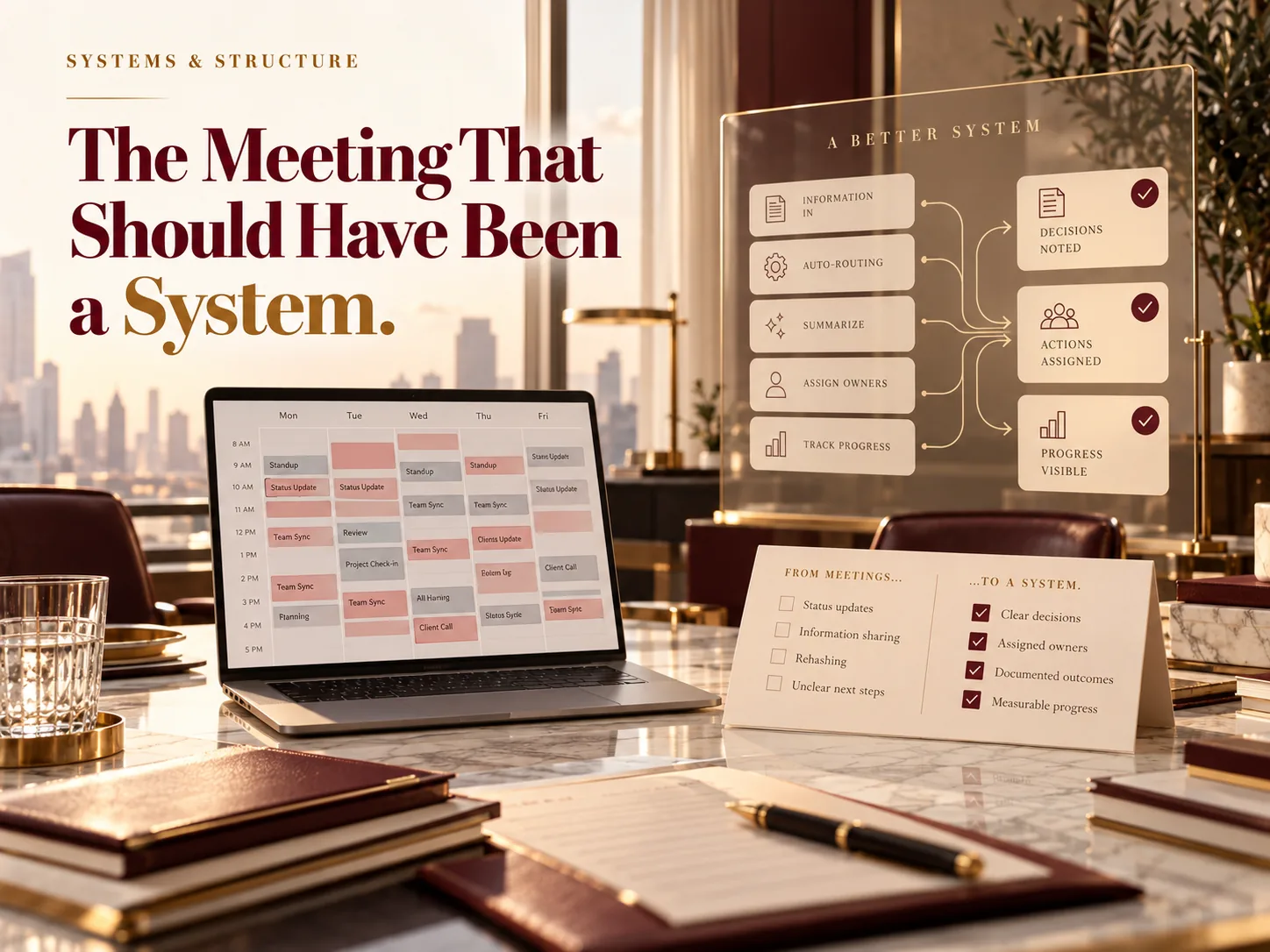
Open a calendar and count the recurring invitations. Weekly syncs, status reviews, standing check-ins, the Monday meeting that has run since a project that ended two years ago. Each one began for a reason. Some of those reasons have since expired.
A recurring meeting is often a structure doing manual work. It exists because information does not move on its own, and the calendar has become the integration layer. People gather to carry facts from one part of the organization to another. The facts could travel without them. The piece on operational architecture describes why structure lags scale. A standing meeting is one of the places where that lag shows up in a form anyone can see by looking at a single week.
Two Kinds of Recurring Meeting
One kind exists to make decisions that need people in a room. Trade-offs get weighed, judgment gets exercised, and someone leaves with a call made. Remove this meeting and the decisions either stall or get made badly, because the conversation was the work.
The other kind exists to move status that should move without people. Someone reports what happened. Others listen. Nothing is decided. The meeting delivers information from where it lives to where it is needed, and the room is the delivery mechanism.
Both kinds sit on the calendar with the same title format, the same duration, and the same invite list. From the outside they look identical. The difference shows only in what the meeting produces. A decision-making meeting produces decisions. A status meeting produces awareness, and awareness fades quickly.
One signal helps separate them. Consider what the meeting would produce if a regular attendee were absent. A decision meeting struggles without the person whose judgment the decision requires. A status meeting runs the same without that person, and someone catches them up afterward.
How a Gap Becomes a Standing Invite
Something falls through once. A handoff is missed, a client hears two versions of a story, a deadline passes unnoticed. Someone proposes a weekly check-in to make sure it does not happen again. The check-in works. Nothing falls through for a while.
The meeting solves the problem that created it, and then it outlives the problem by years. Nobody removes it, because removal looks like risk. The last time the gap was open, something broke. The meeting is the evidence that someone cared, and canceling it reads as caring less.
Meanwhile the invite list grows. New hires get added by default. People who left the original problem behind remain on the list because nobody audits it. The meeting continues to run on the weight of its own history. Years later it has a standing time, a long invite list, and no owner who remembers what it was built to fix.
The Cost Nobody Prices
The hour on the calendar is the visible cost. Multiply it by everyone in the room and the number grows. Multiply that by every week of the year and it grows again. A one-hour weekly meeting with eight people consumes four hundred sixteen hours of attention a year. Most organizations carry several of these.
The calendar hour understates the cost. Each attendee pays a context switch on both sides of the meeting. Work in progress gets set down before it, and picking it back up afterward takes time that appears on no schedule. A person with four meetings in a day has no long stretch left for work that requires one. Standing meetings also set the rhythm of the week. Work organizes itself around them, deadlines cluster the day before, and updates wait for the next meeting before anyone shares them.
The cost also lands unevenly. The people with the most meetings are usually the people with the most decisions to make, so the meetings take hours from the work only they can do.
When a meeting is the only thing moving information, the calendar has become your operating system.
Reading Your Own Calendar
Every recurring meeting answers one question: what would break if it disappeared?
Some meetings would break something immediately. A decision would go unmade, or a team would lose its only moment of shared context. Those meetings earn their place.
Other meetings would break nothing the same day. They would leave a gap that someone would have to fill by another route, a shared document, a message, a dashboard. Those meetings cover for a handoff. Each one marks a place where information has no path of its own.
The pattern holds across functions. Weekly status meetings sit at the boundaries between teams. Reviews sit where one team's data does not reach another's. Standing one-on-ones sometimes carry the work of a process nobody has written, the same gap that produces the undefined role in a hiring decision. Each is a signal about the system beneath it, and the calendar records the signals in plain view. Most of it was assembled one reasonable invitation at a time, which is why no single entry looks like the problem.
The distinction is now available: meetings that make decisions and meetings that carry information. The second group points at the places where the structure is doing manual work.
Removing a meeting that covers a gap without addressing the gap reopens the original problem. Retiring the right meetings, in the right order, with the right replacement behind each one is its own discipline. The calendar already records where the structure is thin, and a leader who reads it that way has done the first piece of the work.